Sunday, March 21, 2010
Friday, March 19, 2010
Be the Hero, Not a Victim - Interview of Author Noah Blumenthal Part III
Noah Blumenthal: First of all, I love the sentiment in this poem. The thing about being a hero is that it is a pragmatic tool for moving forward, not for being perfect. In this moment, right now, what would the hero do? This question isn’t an evaluation of what you’ve done before. It’s a tool to guide you toward a better next step. Who would beat themselves up over their past? The hero or the victim? Obviously the victim. What would the hero do instead? Forgive himself and others if he can. Either way, look forward at what positive action he can take next.The victim and hero mentality is no different. Immerse yourself in heroic thinking for a time. Surround yourself with people who embody heroism. Practice the new behaviors. Before long it will be second nature.
Noah Blumenthal: Seriously, I struggle with patience with my kids, understanding with my wife, acceptance with career situations that don’t go as I’d like. I’m human, and human emotions of anger, frustration, and anxiety are all normal and valuable. They tell us what is happening around us. If there is anything that makes me different, it isn’t that I have a perfect family and career and life. It’s that when things aren’t perfect and I feel these negative emotions I understand them and reverse them quickly, turning them into positive action. And that’s a skill anyone can learn.
Given the times we live in, what do you say to the millions of Americans who studied hard, worked hard, saved hard and did everything right and yet are now finding themselves in a serious lurch because of the economic downturn?
Define lurch. Most Americans are still living in heated homes and eating well. If we all have to spend a few years (or even many years) living a less luxurious life, that isn’t the worst thing in the world. This will pass. Most of the jobless will eventually return to work. Those living with friends or relatives will eventually be able to afford their own place to stay.
If you worked hard, saved hard, and did everything right, go back to doing those things. Reset your expectations and focus on doing what you can today. Even in this economy there will be those who respond well and find success. In fact, this could very well be your greatest opportunity to be the hero.
Related Blog Posts:
Labels: Book Review, Interview
Thursday, March 18, 2010
5 Steps to Be The Hero - Interview with Author Noah Blumenthal
(Click for Part I) This is Part II of a three-part blog interview with Noah Blumenthal, author of Be the Hero: Three Powerful Ways To Overcome Challenges In Work And Life. Gary B. Cohen: What steps would you take to build the hero's mindset in an organization or larger community?
Noah Blumenthal: This is a question of culture change. You could read 100 books on this topic and still have more to learn. But if I were going to distill this down to steps anyone can begin today that can pay some immediate dividends it would be these.
1. Examine your own behavior and be more of a hero yourself. If you don’t lead by example then all of your efforts will be for naught.
2. Recognize and praise heroic attitudes and behaviors. People need clear indications of what is valued.
3. Invite people to join you in your own efforts to be more heroic. As opposed to telling them that they should change explain that this is an area you are working on and would like them to try it with you.4. Search for alternatives to the victim stories. Instead of criticizing people when they fall into victim mode help them to explore other points of view.
5. Share Be the Hero with your team. Having a collective knowledge base can help you and your team hold one another accountable and increase your learning.
Gary B. Cohen: As a leader, how do you handle those co-workers whose stories may never change?Specific to this issue of heroism I suggest you follow the steps I described above relative to creating a heroic culture. If after that you are really convinced that someone will never change, then get away from him/her. If it’s your boss, look for a new job. If it’s a colleague, angle for projects that don’t involve him/her. If it’s an employee, coach them out of the role or let them go. That may sound harsh, but in my experience most people who are let go from jobs in which they are miserable find a better alternative. It might hurt short-term, but the end result is positive. And the fewer victims you have in your life, the easier it is for you to think and act like a hero.
Second, understand that “being a hero” is a skill. The more you practice the better you’ll be. It drives me absolutely crazy, but I wrote the book for crying out loud. And I still catch myself going into victim mode at times. That said I don’t go into victim mode as often as I used to and I get out of that mode much faster today than I ever did in the past. Keep practicing and you’ll get better every day.
How do you prevent yourself from the trap of…having to be good…and not accepting yourself?
Additional Blog Posts on this topic:
- Noah Blumenthal Be the Hero - Interview Part I
- 5 Steps to Be The Hero - Interview with Author Noah Blumenthal Part II
- Be the Hero, Not a Victim - Interview of Author Noah Blumenthal Part III
Labels: Book Review, Interview
Wednesday, March 17, 2010
Noah Blumenthal Be the Hero - Interview
Noah is the Founder and President of Leading Principles, Inc., an executive coaching and consulting company that helps people see the best in themselves and become more confident, energized, and effective in their work. Noah started his coaching career as a founding member of UBS Financial Services’ internal consulting group for team development and leadership coaching. He consulted with over one thousand line, management, and executive teams and coached hundreds of team leaders on how to change their behaviors. In 2003, he followed his dream of building exceptional leadership skills with an even broader audience and left UBS to start Leading Principles.
Noah is a seasoned speaker and trainer, delivering keynotes and workshops on executive coaching, individual development, and team building. He has been a guest lecturer at Columbia University, The New School, Baruch College, Fordham University, the American Society of Training and Development, and the International Coaching Federation. Noah Blumenthal: I was trying to answer the question, “How?” We spend most of our time on, “What?” What does great performance look like? Great leadership or sales? Great parenting? But none of this knowledge matters if we don’t know how to master ourselves – how to bring out our own best thinking, decision-making, energy, emotions, and performance.
Labels: Book Review, Interview
Tuesday, March 16, 2010
IPhone App Hits Top Ranking - Just Ask Leadership
Under the Category of Business Just Ask Leadership IPhone App ranks in the top 300 Apps in the USA among other countries. The position for each country is the one last registered by PositionApp™. This is based on monthly averages. Country Position Movement
Philippines 134
Qatar 139 new
UK 159
Indonesia 160
Malaysia 21
India 23
Norway 239
Singapore 242
USA 255
Saudi Arabia 261
Denmark 269
Check out the App at the App Store!
Labels: iPhone App
Leadership is engaging people to - Jump in Head First!
The people I love the best
jump into work head first
without dallying in the shallows
and swim off with sure strokes almost out of sight.
They seem to become natives of that element,
the black sleek heads of seals
bouncing like half-submerged balls.
I love people who harness themselves, an ox to a heavy cart,
who pull like water buffalo, with massive patience,
who strain in the mud and the muck to move things forward,
who do what has to be done, again and again.
I want to be with people who submerge
in the task, who go into the fields to harvest
and work in a row and pass the bags along,
who are not parlor generals and field deserters,
but move in a common rhythm
when the food must come in or the fire be put out.
The work of the world is common as mud.
Botched, it smears the hands, crumbles to dust.
But the thing worth doing well done
has a shape that satisfies, clean and evident.
Greek amphoras for wine or oil,
Hopi vases that held corn, are put in museums,
but you know they were made to be used.
The pitcher cries for water to carry
and a person for work that is real.
Labels: Poem
Sunday, March 14, 2010
Prepared for Randomness
If any doubt remained, so you are not fully convinced of your success, you will become so when the university asks you to speak to a new batch of students or when the industry publication chooses your picture for it's cover. Your clinging attachment to the principles of order and predictability overrun the tug in your heart that knows much of your success can actually be attributed to sheer randomness. It is not that you're not smart or that you didn't work hard to be successful, it's that something is pulling on you deep down that knows had you not sat next to that certain person on the first day of class you would likely never have become business partners. Same for being chosen Chief of Staff at the White House or being hired as the CEO of a multi national company ......... you get my point. How often is it said that those you meet the first day of school become your closest friends? Random luck, fate as some call it..........
If success only came from being smarter, the more knowledge you accumulate the more successful you ought to be. My guess, however, is that you'd be more successful if you create more favorable coincidences. In other words, place yourself in situations where you're bound to make important connections. People who go to Harvard are undoubtedly smart, but their success is often due to the connections they make at such a high-powered school.
It's important to create favorable coincidences for your business. If your business has a single page for google to find with no updates, your chances of attracting web business is akin to winning the lottery. If you blog frequently, promote your business on other sites, fill the net with 1,000 of pages of content, your prospects go way up.
In our former business, we went to 16 trade shows per year: a great deal more than any competitor of our size (we were small). We wound up landing our largest client that made us a run-away success. The reason we won the contract over 50 competitors was that we were based in Minnesota and our client was from Minnesota and he wanted to visit family. Coincidence? Partly. We increased the chance of randomness/coincidence favoring us by being at so many trade shows. If we had not landed that client, the $150,000 bet would have been a bust.
The factors that will help you find favorable coincidences:
- Ability to outlast the long tail to hit the favorable random event - if you can keep at it long enough, you're bound to hit a break.
- Be prepared enough so that if fortune happens you can harvest that opportunity.
- Expose yourself to as many opportunities as you can so your chances of positive outcomes increases. Tenacity really helps.
Labels: Business Plans, Leadership
Wednesday, March 10, 2010
Let the Crazy Out a Little at a Time!
All leaders bring unique characteristics and histories with them on the rise to the top. Like you and me, they're human. Sometimes, though they want to forget or hide parts of their past, of themselves--the parts they find embarrassing or unbefitting their current position. The more they try to hide or forget, the more potential there is for damage--to themselves and, perhaps, others. The more they bottle up, the farther the cork flies and liquid spills.
Rather than having an "I am who I am, and I'm never going to change!" explosion, I let the crazy out just a little bit at a time. It honors the shadow side of myself, yet prevents my aberrant behaviors from showing up at the wrong times.
We're all capable of change and growth. Still, by keeping some of that craziness with you throughout the change, the beautifully unique you will remain.
Labels: Leadership of Self
Tuesday, March 9, 2010
Is Your Leadership Encouraging Screen or Face Time?
Is your obsession with order driving your company to input more data and generate more reports? Is it distracting your employees from delighting your customer?
Yesterday, a hundred megabyte drive was sufficient storage; today it's in the terabytes. The drastic reduction of costs associated with data storage is allowing companies to save, compile, and sort to discover incremental performance of their people. This incessant need to measure, control, and create predictability within the business may be having a counter-intuitive effect on the company and its staff's abilities to serve the customer, however.
In order to successfully use all this data, it needs to be converted into actionable information. Which means someone is entering the data, another is determining the relevancy, and your managers are reading it to take actions. What used to be a single document is now a dashboard full of meters, indicators, and controls. And it's eating up lots of your organization's energy and time. While you're all assessing the data piles, who is serving the customer?
It might be helpful to think of this as Screen Time (data collection, information assessment, and dash board controls) verses Face Time (human-to-human interactions). What is your Screen Time to Face Time ratio? What is it for your front-line employees and their managers? If you're like many companies, your supervisors are becoming less capable of managing people (Face Time) and more capable of managing information (Screen Time). Here's the problem: As you try to move all this information to action, your people can no longer effectively engage customers. They have stopped building their people strengths by spending too much time on Screen Time.
Labels: Culture, Leadership, Leading Organizations
Monday, March 8, 2010
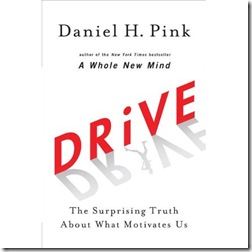
Dan Pink - Interview on Drive: The Surprising Truth About What Motivates Us
Dan Pink: Motivation 2.0 is built around our reward-and-punishment drive. It presumes the way that people perform at the highest level is by offering them carrots for the behavior you seek and sticks for the behavior you want to deter. That approach -- that motivational operating system, if you will -- can be effective for certain kinds of tasks. But for complex, creative, and conceptual tasks, it's usually a bad idea. The better approach there is Motivation 3.0, which is built around another of our drives -- our innate need to direct our own lives, to learn and create new things, and to do better by ourselves and our world.
Gary B. Cohen: What do autonomy, mastery, and purpose have to do with motivation?
Dan Pink: These three elements are at the heart of this newer, more effective approach to motivation. If we really want high performance -- especially on complex, creative, and conceptual work -- people have to have freedom to do work their own way. They must be able to make progress, to get better at something that matters. And they're more likely to really excel if what they do is in the service of something larger than themselves.
Gary B. Cohen: My book, Just Ask Leadership, examines how leaders can increase alignment, engagement, and accountability by asking more and better questions. How might this approach align with Motivation 3.0?
Dan Pink: It aligns extremely well. One of the simplest pieces of leadership and management advice I give is this: "Listen more, talk less." Asking questions is a way to hone your listening and hear other voices rather than just your own.
Gary B. Cohen: It is not unusual for the science of a subject, in this case motivation, to appear far in advance of implementation. Is there anything particular to our culture that will affect this lag time, specifically as it relates to how we practice motivating others?
Dan Pink: Interesting question. I'm not sure, actually. But cycle times for everything are accelerating. So there's a chance, I guess, that once the science is exposed and revealed a little more clearly, organizations may move somewhat more quickly than in the past.
Gary B. Cohen: What is the danger for those of us who continue to only use the carrot-and-stick approach or move to only intrinsic motivation?
Dan Pink: The danger of using only carrots and sticks is that they're ineffective for many types of work. What's more, they can bring a cascade of other negative consequences -- locking people in to short-term thinking, tamping down creativity, and even enticing some people to cheat. The danger of using only intrinsic motivators is overlooking that money is a motivator. If you don't pay people enough -- if they're not being compensated adequately or if they can't support their family -- you're not going to get any motivation at all. The idea that intrinsic motivators can somehow substitute for fair pay is a colossal mistake.
Gary B. Cohen: What five tips do you have for organizations wanting to switch to Motivation 3.0?
Dan Pink:
- Understand the limits of carrots and sticks -- and use them only where they're effective.
- Do whatever you can to provide employees with more autonomy over their time, their team, their task and their technique.
- Encourage people to supplement traditional performance reviews by doing their own performance reviews -- setting out their monthly goals, for instance, and self-evaluating at the end.
- Take a day when people can work on any idea they want -- then show the results to the rest of the company the following day. These one-day sessions of intense autonomy -- known as FedEx Days, because people have to deliver something overnight -- have proven incredibly productive.
- Infuse the workplace with a purpose larger than simply making the numbers or increasing earnings per share by two cents this quarter. Supplement the profit motive with the purpose motive.
Related Blog Post: Motivation Video by Dan Pink
Labels: Book Review, Interview, Leadership of Others, Leadership of Self
Great Leader vs. Great Manager Is There A Difference?
Labels: Accountability, Creating Change, Executive Coaching, Executive Leadership, Just Ask Leadership, Leadership, Leadership Definition, Leadership of Other, Leadership Skills
Saturday, March 6, 2010
Questioning Tips: Let Go of Your Answer
Let go of your answer when asking!
Labels: Just Ask Tips, Leadership of Self, Questioning
Questioning Tip: killing questions
Try not to rush yourself and others. After you ask a question, pause. As you look at the other person, reveal with your eyes that you're not impatient for an answer. Share the silence until they are ready to share their story. They will appreciate the time to collect their thoughts, and you will appreciate more thoughtful and better-formed answers.
After you ask a question, give pause and listen deeply to the other.
Wednesday, March 3, 2010
Minneapolis Job Market Flat
Minneapolis, MN – February’s jobs report from the Department of Labor is scheduled to be released later this week and based on data released this morning by LinkUp, Friday’s report will show that the job market was essentially flat in February, making only modest gains in job growth.
LinkUp, a job search engine that indexes jobs from over 20,000 company websites throughout the U.S., reported that new job listings on company websites rose by 10,201 (2%) from January. Total job listings on company websites in LinkUp’s job search engine increased by 7,740 (1%). While the slight increase is certainly welcome news in an otherwise painfully slow and rocky recovery, February’s job gains pale in comparison to January’s blistering gains in new and total job listings of 69,082 (18%) and 34,525 (4%) respectively. January’s strong LinkUp numbers may have been strong enough to indicate solid job gains across the nation last month.
Find complete press release attached or on JobDig
Labels: Economics
Tuesday, March 2, 2010
More Economical to Manufacture in US over China
Labels: Leading Organizations
Log Jam in Congress on Tax Laws
This country has a great and energetic workforce; we just need to move them in a productive way.
The panel at Allied Executive Symposium urged business leaders to reach out to congress!
Panel Discussion on Economic Outlook for 2010
GeoTagged, [N44.97292, E93.27363]
Keynote Speaker: Narayana Kocherlakota, President of The Federal Reserve Bank of Minneapolis.
Panel included:
Dean Bachelor - CEO Platinum Group
Scott J. Dongoske - President Winthrop & Weinstine
Al Gerhardt - COO Kraus-Anderson
Elliot Jaffee - TC President US Bank
Michael Lacey - CEO Digineer
Beth Kieffer Leonard - Managing Partner LBLCo
Cary Musech - managing Principles Tonka Bay Equity Partners
Jean Taylor - CEO Taylor Corp.
Scott W. Wine - CEO Polaris
John P. Palen - CEO Allied Executives
Most of the panelists predict that revenues will hold steady this year or experience some growth. The construction industry, which has 25 percent unemployment, is an exception. That industry doesn't expect improvement until mid-2011. The technology companies see greater growth than others based on 4qtr of 2009 and 2010. Law firms believe the bottom has hit. Taylor Corp sees change as moving into more technology, as well as a move to an operational excellence model. Taupe says this is the year of revenue growth. Polaris echoes that sentiment. Polaris is focusing on sales. For Platinum group, being in a turnaround business, the phone has not stopped ringing.
How are these companies changing?
Polaris does not see cutting costs as a strategy; it is about reengineering products to offer more for less. Taylor is focusing on return on investment. Tonka Bay talked a lot about its strategic competitive advantage. Oftentimes business leaders talk about what we have rather than thinking more strategically. Tonka Bay is out looking for talent and deals. First Bank started annual business reviews with customers. Krause-Anderson believes we should never waste a good crisis.
A tactical solution is moving to teleconferencing. Winthrop is closing deals in the middle of a blizzard becase of its use of technology in video web conferencing.
Taylor is looking at partnerships with what would have been competitors in the past. They are deciding to focus on what each does well and how each side can have greater leverage.
The panel's take on banking issues: Banks have not taken time to understand the customer. Because of this, we are all learning what we have to do to support customers. Credit is available to those that have credit-worthy ventures for those banks that have the liquidity. If you are feeling like you're experiencing unfair treatment, it may have nothing to do with your business but it might be the bank. Talk to your bank often and early. Start planning you loan agreements 6 months ahead.
One panelist described a business that was doing a telemarketing campaign and, due to a technological glitch, called and hung up five times on a customer. The customer tried to call back, but was not able to get to through. The company was able to connect with this customer through Twitter, though. The executive who relayed this story was proud of the multiplatform coverage. He should be, but not if some of the older platforms are prone to such glitches. Not many customers would be able to look past the five hang-ups.
President of the Federal Reserve Bank speaks about the Fed's Authority
"No matter how bad things are, it could have been much much worse," Kocherlakota said about the banking and mortgage crisis.
For the Fed, it may get worse. Congress is currently considering retracting some of the authority of the Federal Reserve. One of the greatest powers of the Fed is its ability to regulate risk with its own supervisory authority. This authority helps control quantity and allocation of liquidity. It was the use of these mechanisims that led to a 200,000% increase in loans to banks in 2008.
The purpose of these loans is to ensure insolvent firms fail and solvent firms survive. Today the fed can turn to its supervisory authority to make or withdraw such allocations. If that was taken away from the Fed, would the Fed be able to act in time to avert risks? The bigger problem is that today if the Fed gives a bad loan, it shows up on the Fed balance sheet. Under other terms, it would not have the same accountability, nor would a secondary regulatory authority.
It took the Fed two months to conduct the financial stress test. With less authority, how much longer would that test have taken?
Congress is thinking of keeping the authority over large banks, but not small banks. What's to prevent small banks, collectively, being a disruptive force in the future?
An audience member asked, "Why should we trust the Fed after the events of the past two years?"
Kockerlakota said that the economy is on the mend--not as quickly as we'd all like, but inflation is under control and there are other hopeful signs. He noted that we need to be more concerned in the future with the gravity of incentives, which have a big impact on the effectiveness of regulations.